
+ More ⏷

Every month, someone in HR or accounts sits down and turns attendance records, salary structures, and a pile of allowance rules into one number per employee: what they’re actually getting paid. That document is the salary sheet. It covers everyone on payroll at once, which is what separates it from a payslip — the individual, employee-facing version of the same calculation.
Who builds it depends on company size. At a small company, it’s usually one person in Excel. At a larger one, payroll software pulls attendance and leave data in automatically and does most of the math. Either way, it sits between three things: HR (who decides the salary structure), attendance and leave records, and finance (who actually releases the payment).

Coordinates: 23.74833250, 90.37188170
Suburbs Around Newstead:
Table of Contents
Salary sheet format in Bangladesh
There’s no legally mandated format for this. The table below is a common, workable structure, not a rule every company has to follow. What you actually include depends on your salary structure, which allowances your company pays, and which deductions apply.
| Employee ID | Name | Designation | Department | Basic | House Rent | Medical | Conveyance | OT | Gross Salary | PF | Tax | Other Deduction | Net Salary |
|---|
Most Bangladeshi salary structures split gross pay into a basic salary plus allowances (house rent, medical, and conveyance are the usual three), add any variable pay like overtime, then subtract deductions such as provident fund, tax, or loan repayments to land on net salary.
It differs from a salary slip. A slip is a routine monthly payroll record for one pay period. A certificate is an on-demand summary meant for an external party, such as a bank, embassy, or landlord, and it needs a signature (and usually a seal) to carry any weight.
What distinguishes a simple HR tool from an end-to-end HRMS solution is how integrated these modules are. Forget about manually cross-referencing three spreadsheets every month when attendance data goes straight into payroll and leave records automatically update.
Salary sheet components
Employee information. ID, name, designation, department, joining date — the fields that tie the payroll row back to an actual HR record.
Basic salary is the fixed core of the pay package. In many companies, house rent, PF contribution, and gratuity are calculated as a percentage of this figure. That’s a policy choice each company makes, not a fixed rule, so don’t assume one ratio applies across the board.
House rent allowance is usually the biggest single allowance. Some companies set it as a flat amount, others as a percentage of basic salary — it varies by company policy.
Medical allowance is typically a fixed monthly amount meant to cover routine medical costs.
Conveyance or transport allowance covers commuting. A few companies provide actual transport instead of paying this in cash.
Overtime is extra pay for hours beyond the standard schedule. It’s calculated separately from the fixed components and only shows up in the months it’s actually worked.
Festival bonus is typically paid around Eid or other major holidays, on top of the regular monthly salary, and usually kept as its own line rather than folded into gross pay.
Provident fund (PF) is a retirement savings contribution, usually split between employee and employer, and it shows up as a deduction on the employee’s side of the sheet. Worth knowing: under the Bangladesh Labour (Amendment) Ordinance, 2025, gazetted in November 2025, PF became mandatory for establishments with 100 or more workers. Smaller companies can still offer one voluntarily, but check which threshold applies to you before setting policy.
Income tax (TDS) is deducted at source based on annual taxable income and whatever tax-free threshold and slab rates the National Board of Revenue sets for that fiscal year. These change almost every Finance Act, so don’t trust a number from an old article. Check nbr.gov.bd or a current tax circular before you calculate anyone’s actual deduction.
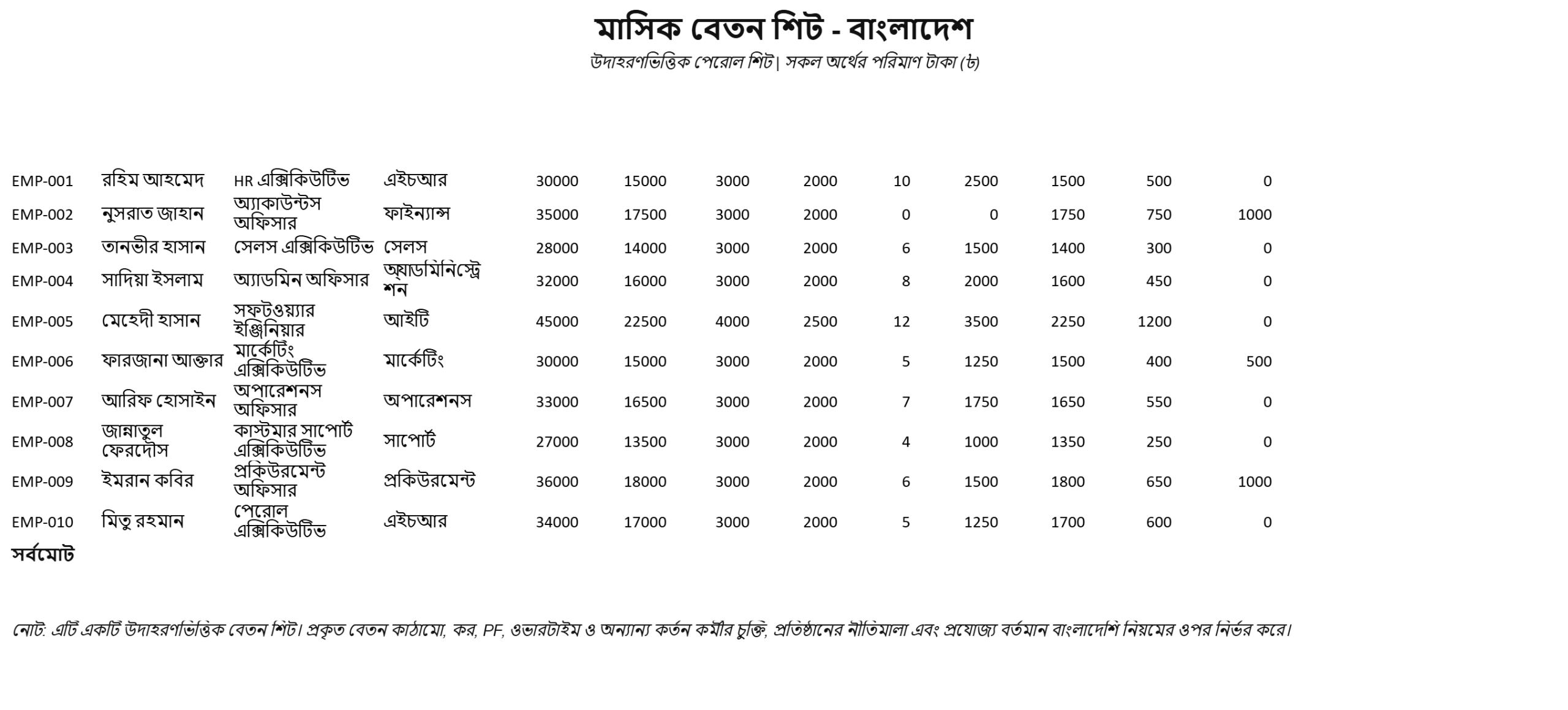
Bangla
How to calculate a salary sheet
The math is the same regardless of company size. Three steps:
Gross Salary = Basic Salary + House Rent + Medical + Conveyance + Overtime + Other Earnings
Total Deductions = Provident Fund + Tax + Loan/Advance + Other Deductions
Net Salary = Gross Salary − Total Deductions
The percentages behind each line — how much house rent, what PF rate, which tax bracket — come from your company’s compensation policy and current NBR and Labour Act rules. There’s no single formula that applies to every business in Bangladesh, so treat the structure above as the shape of the calculation, not the actual numbers to use.
Worked example
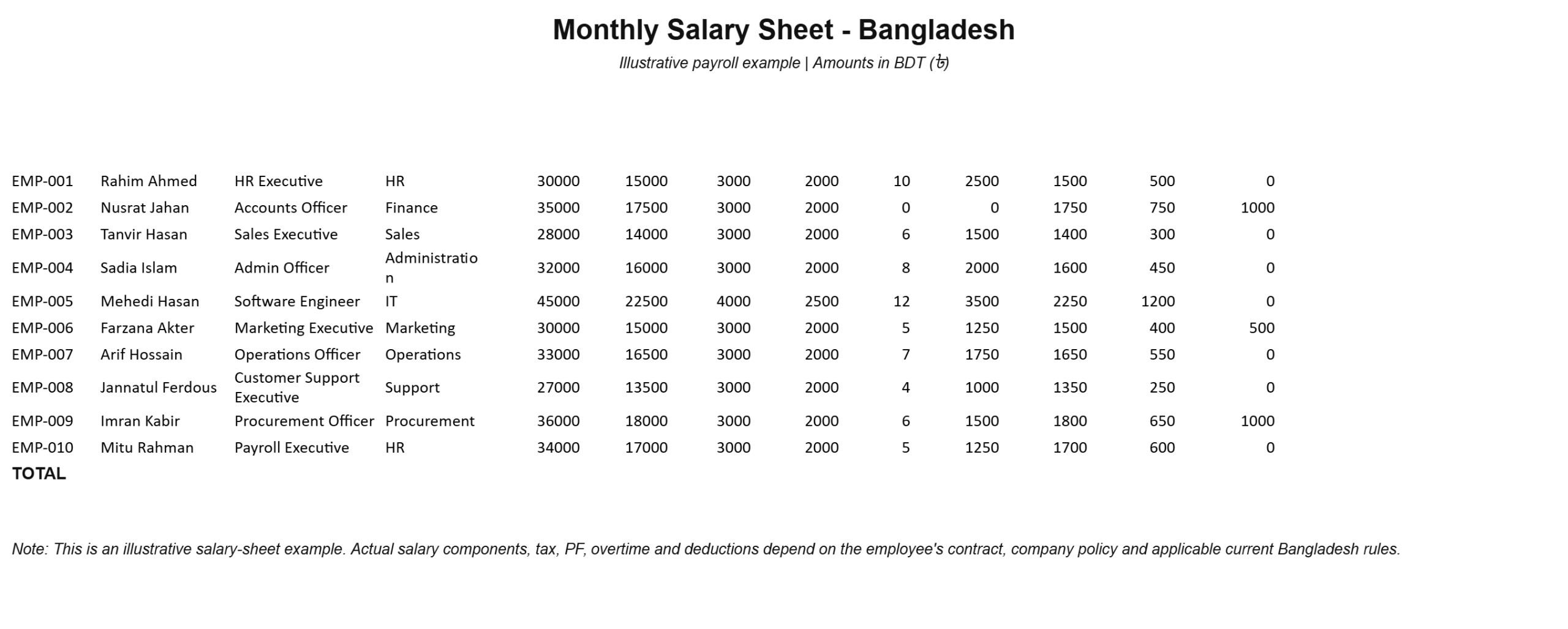
Here’s a small salary sheet for ten employees, with Gross and Net Salary actually calculated from each person’s components (not just illustrated in the abstract). The specific allowance amounts, OT pay, PF, and tax figures are example numbers, not statutory rates.
| ID | Name | Designation | Basic | House Rent | Medical | Conveyance | OT | Gross | PF | Tax | Other | Net |
|---|---|---|---|---|---|---|---|---|---|---|---|---|
| EMP-001 | Rahim Ahmed | HR Executive | 30,000 | 15,000 | 3,000 | 2,000 | 2,500 | 52,500 | 1,500 | 500 | 0 | 50,500 |
| EMP-002 | Nusrat Jahan | Accounts Officer | 35,000 | 17,500 | 3,000 | 2,000 | 0 | 57,500 | 1,750 | 750 | 1,000 | 54,000 |
| EMP-003 | Tanvir Hasan | Sales Executive | 28,000 | 14,000 | 3,000 | 2,000 | 1,500 | 48,500 | 1,400 | 300 | 0 | 46,800 |
| EMP-004 | Sadia Islam | Admin Officer | 32,000 | 16,000 | 3,000 | 2,000 | 2,000 | 55,000 | 1,600 | 450 | 0 | 52,950 |
| EMP-005 | Mehedi Hasan | Software Engineer | 45,000 | 22,500 | 4,000 | 2,500 | 3,500 | 77,500 | 2,250 | 1,200 | 0 | 74,050 |
| EMP-006 | Farzana Akter | Marketing Executive | 30,000 | 15,000 | 3,000 | 2,000 | 1,250 | 51,250 | 1,500 | 400 | 500 | 48,850 |
| EMP-007 | Arif Hossain | Operations Officer | 33,000 | 16,500 | 3,000 | 2,000 | 1,750 | 56,250 | 1,650 | 550 | 0 | 54,050 |
| EMP-008 | Jannatul Ferdous | Customer Support | 27,000 | 13,500 | 3,000 | 2,000 | 1,000 | 46,500 | 1,350 | 250 | 0 | 44,900 |
| EMP-009 | Imran Kabir | Procurement Officer | 36,000 | 18,000 | 3,000 | 2,000 | 1,500 | 60,500 | 1,800 | 650 | 1,000 | 57,050 |
| EMP-010 | Mitu Rahman | Payroll Executive | 34,000 | 17,000 | 3,000 | 2,000 | 1,250 | 57,250 | 1,700 | 600 | 0 | 54,950 |
| Total | 562,750 | 538,100 |
Take Rahim Ahmed (EMP-001). Gross is 30,000 + 15,000 + 3,000 + 2,000 + 2,500 = ৳52,500. Deductions are 1,500 (PF) + 500 (tax) = ৳2,000. Net is 52,500 minus 2,000, or ৳50,500. Every other row runs the same math; only the inputs change.
All figures above are illustrative payroll examples. Actual salary components, tax, PF, overtime, and deductions depend on each employee’s contract, company policy, and current Bangladesh rules.
Salary sheet format in Excel
Most small and mid-sized companies in Bangladesh still build this in Excel before they eventually move to payroll software. A workable column layout:
A — Employee ID          F — Medical            K — PF
B — Employee Name        G — Conveyance          L — Tax
C — Designation          H — Overtime            M — Loan/Advance
D — Department           I — Gross Salary        N — Other Deductions
E — Basic Salary                                 O — Net Salary
Set Gross Salary as =SUM(basic:overtime) and Net Salary as =Gross - SUM(deductions), so the sheet recalculates itself whenever an input changes. That’s the same logic as the worked example above. Where Excel starts to strain is scale: once attendance, leave, overtime rates, and tax rules all live in separate files, keeping one spreadsheet accurate every single month gets genuinely hard to sustain, and it’s usually not obvious it’s wrong until someone complains about their pay.
Salary sheet vs. salary slip vs. payroll register
| Document | Purpose |
|---|---|
| Salary Sheet | Summarizes payroll calculations for all employees in one register |
| Salary Slip / Payslip | Shows one employee’s individual earnings and deductions |
| Payroll Register | Payroll records kept for accounting, audit, and compliance purposes |
Terminology isn’t fully standardized. Some companies use “salary sheet” and “payroll register” interchangeably, so don’t assume a vendor or client means exactly what you mean by either term.
Common salary sheet mistakes
The same handful of errors show up over and over in manually maintained salary sheets:
Using outdated tax slabs, because NBR revises the tax-free threshold and rates almost every Finance Act, so last year’s numbers are often already wrong.
Mixing up gross and basic salary when calculating allowances or PF, so the wrong base figure gets used. Forgetting to add overtime for the actual month it was worked.
Leave and absence deductions that don’t match the real attendance record. PF percentages that are still set to the old rule after the Labour Act change. Bonuses or arrears from a previous month that never got added in.
A copied formula or cell reference in Excel that quietly stops updating. No salary history kept anywhere, which becomes a real problem the first time an employee disputes a past payment.
Payroll and attendance data that disagree because they live in two different files. And re-typing the same employee details every single month instead of keeping one master list.
How HRMS software can automate salary sheets
A salary sheet gets hard to maintain by hand once attendance, leave, overtime, salary structure, and deductions are scattered across separate files. One missed update in any of them throws off the whole sheet, and it’s rarely caught until payday.
HRMS BD’s payroll management connects salary calculation directly to attendance and leave records, so gross pay reflects days actually worked without someone cross-checking by hand. It applies each employee’s salary structure — basic, house rent, medical, conveyance, and any custom components a company adds — the same way every month, handles overtime and PF automatically, and produces digital payslips and payroll reports both employees and finance can actually rely on.
Frequently asked questions
What is a salary sheet in Bangladesh? A monthly document listing every employee’s salary components, deductions, and net pay. HR or payroll prepares it to process salary payments and keep payroll records.
What should a salary sheet include? At minimum: employee ID and name, basic salary, allowances (house rent, medical, conveyance), overtime, gross salary, deductions (PF, tax, other), and net salary.
How is net salary calculated from a salary sheet? Add up the earnings — basic salary, allowances, overtime — to get gross salary. Subtract total deductions (PF, tax, loans, other) to get net salary.
Can I create a salary sheet in Excel? Yes. A basic version works fine in Excel using SUM formulas for gross and net salary. Most teams eventually move to payroll software as headcount and rule complexity grow, but Excel is a reasonable starting point.
What’s the difference between a salary sheet and a payslip? A salary sheet covers everyone for one pay period. A payslip is the individual breakdown given to a single employee.
Does a salary sheet include overtime? Where it applies, yes. It’s usually added as a separate line for that month rather than built into the fixed monthly components.
Does a salary sheet include provident fund? Where a PF scheme applies, yes. It shows up as a deduction on the employee’s side, and often an employer contribution is tracked separately alongside it.
How can HR software automate salary sheets? By linking attendance, leave, and salary structure so gross and net pay calculate automatically each month instead of being rebuilt by hand.
Note: Salary structures and tax treatment vary by employee, company policy, and current Bangladesh regulations. Verify statutory figures — tax slabs, PF rules, and Labour Act provisions — against NBR and official government sources before using them for actual payroll.
Still managing salary sheets manually? See how HRMS BD’s payroll system works.